

Manifestations are, for some people, a main priority from the get-go. For others, it just feels like ticking a box.
There are a lot of misconceptions when it comes to this topic. Some people think boring equals compliant. Others think they can get away with having nothing on certain glass. And then there are the ones who go overkill on bits of glass that didn’t even need it in the first place.
In this guide, we’re going to clear up all of these misconceptions — and show you how manifestations can be utilised to genuinely transform your office and commercial spaces.
Do manifestations have to be boring?
Well, I mean… they can be.
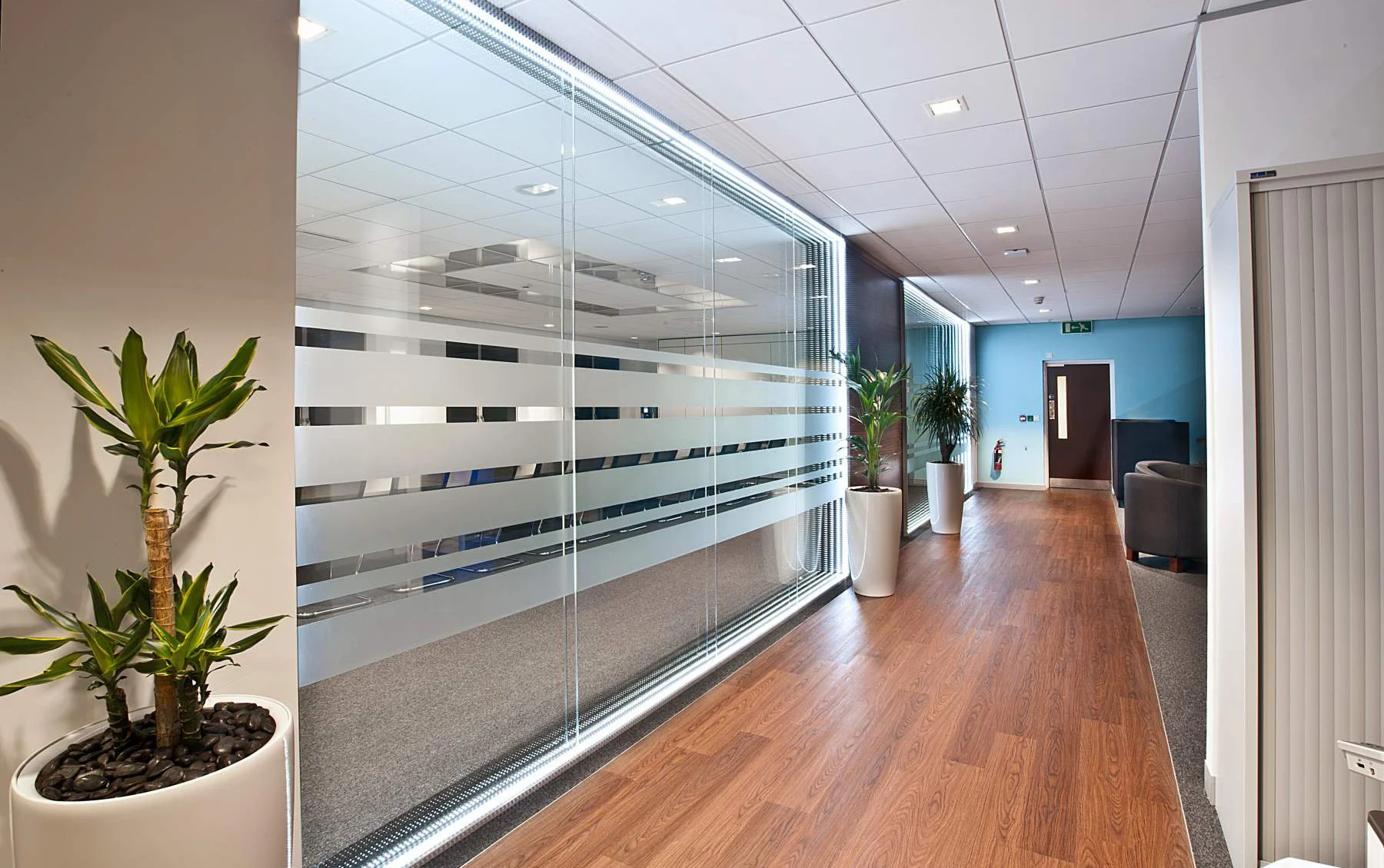
Frosted bands
Frosted bands are classic. They’re boring, sure, but they remain fully compliant and can look great in the right setting. Most frosted film is cheap and cut from the roll, so the cost for the owner is often lower than they expect. It comes in a range of colourways and textures, too — not just plain white.
If one panel gets damaged, there’s no printing involved. We simply come back and refit the panel straight from the roll. Quick, clean, done.
Frosted dots
If you want to go even more minimal, let’s talk frosted dots. These can be great for certain spaces. They’re mess-free, can be applied dry, they’re cost-effective, and they get the job done. We charge anywhere from £25–50 per linear metre (plus additional costs) to have these supplied and fitted. That means you could have your whole space looking compliant for less than a takeaway would cost. Mental.
Custom manifestation markings
But hang on — your dots don’t have to be dots. Maybe you want coffee beans if you own a coffee shop. Maybe you want your company logo, hexagons, triangles. The sky is the limit. Custom markings at the appropriate heights can be eye-catching and an amazing way to express your brand identity whilst ticking the compliance box.
Are you bored yet?
Good. I’m glad you are, because I am too. Let’s talk about the new kids on the block.
Reeded film
This stuff has just taken off recently for commercial spaces. Similar in compliance to frosted bands, just triple the price. It’s a pain in the arse to fit, but when it’s finished the displaced vision looks absolutely stunning — it’s hard to beat it. If you want your space to look high-end, this is the one.
Opticlear (printed optically clear film)
Opticlear is an optically clear material that can have pretty much anything printed onto it. Maybe you want a snazzy gradient, bubbles, your company logo in full colour. It’s a modern, vibrant, and amazing way to make your space compliant without sacrificing natural light or visibility.
Frosted cutouts
Does what it says on the tin — cut out any kind of pattern or design you like from frosted material. It’s got its own place and feel to it. A timeless classic that will never be replaced.
Right, but when do you actually need them?
This is where people get confused. Not every piece of glass needs manifestation markings. Here’s what the law actually says.
The regulations that apply
There are four pieces of legislation that cover glass manifestation in the UK:
| Regulation | What it covers |
|---|---|
| Approved Document K (Building Regs 2010, Requirement K5.2) | Transparent glazing must “incorporate features which make it apparent” |
| Approved Document M (Building Regs 2010) | People with visual impairment must be “in no doubt about the location of glass doors and screens” |
| Regulation 14 (Workplace Health, Safety and Welfare Regulations 1992) | Employer duty — transparent surfaces must be “appropriately marked” |
| BS 8300:2018 | Technical standard specifying contrast values, height bands, and permanence |
Where manifestation is legally required
- Glass in doors — any glazing wholly or partially within 1,500mm from floor level
- Glass adjacent to doors — within 300mm horizontally from the edge of a door AND within 1,500mm from floor level
- Full-height glazed screens and partitions in non-domestic buildings
- Any transparent glazing that people are likely to walk into whilst moving through the building
Where it’s NOT required
- Domestic homes (houses and flats)
- Glazing under 400mm wide
- Glass with railings between 600–1,500mm in front of it
- Single-pane doors with substantial frames
- Doors with large pull handles or push plates that make the glass obvious
So if you’ve been told you need manifestations on every window in the building — you probably don’t. But if you’ve got full-height glazing, glass partitions, or glass doors in a commercial space, you almost certainly do.
Placement heights
The markings must be at two specific height bands:
- Lower band: 850mm–1,000mm above finished floor level
- Upper band: 1,400mm–1,600mm above finished floor level
Both bands must run the full width of the glazed area. This is non-negotiable — get the heights wrong and you’re technically non-compliant even if the markings look great.
Design minimums
- Logos or signs: minimum 150mm high
- Decorative features (broken lines, continuous bands): minimum 50mm high
- Dots or squares: 50–75mm diameter
- Must contrast with the background seen through the glass in all lighting conditions
- BS 8300 specifies a minimum 30-point LRV difference between the manifestation and background
Who is responsible?
- Employers under the Health and Safety at Work Act 1974
- Building owners and landlords
- Tenants, managing agents, and facilities managers — anyone with control over the workplace
What happens if you don’t comply?
- HSE enforcement action following inspection
- Personal injury claims (no-win-no-fee solicitors actively pursue glass collision cases)
- Equality Act 2010 claims — failure to provide an accessible environment
- Insurance implications — non-compliance may void your employer’s liability cover
- Building control enforcement notices
Approximately 210,000 people attend hospital annually in England and Wales for glass-related injuries. It’s not a grey area — this stuff matters.
So what should you actually do?
Honestly? It depends on your space, your budget, and whether you want the manifestations to be a design feature or just a legal tick-box.
If you’re not sure what you need, or you want to explore options that actually make your space look better rather than worse — drop us a message. We cover Essex and London and we’ll give you a straight answer on what’s required and what’ll look best.
Work out your costs
Want a rough idea of how much your project might cost before getting in touch? Use our window film calculator to estimate your total area and get an instant ballpark figure.